
Abstract
Upon my arrival to the Prins Bisschopsingel (PBS) office on October 24, I discovered a “Hamsa Hand keyholder” positioned on my desk. I promptly surmised that Joke van Daalen (FIC General Secretariat) had positioned it there as a present, having recently returned from her holiday in Morocco, North Africa. Subsequently, Joke sent me an email including literature regarding the Hamsa Hand. After meticulously examining the information, I was intrigued to investigate this “spiritual symbol” to uncover its profound significance. Presenting a Hamsa Hand as a gift signifies the expression of desires for safety, happiness, and success. I express my gratitude to Yoke for her thoughtfulness, benevolence, and love. This study presents pertinent information concerning the Hamsa Hand from a Christian perspective.
Keyword: amulet, evil eye, emblem of protection, gift-giving, interconnectedness of humanity, open hand, security, spiritual well-being, symbolism
Introduction
Throughout history, people have pursued safety from the unknown using symbols and talismans. These objects, imbued with significance through our beliefs and faith, serve as a potent reminder of our link to a larger force in the universe. The Hamsa Hand is a symbol that is widely recognized in numerous cultures and religions. This timeless symbol has evolved beyond its beginnings to serve as a global emblem of safeguarding, power, and goodwill.
The Hamsa transcends mere symbolism; it serves as a poignant reminder of our shared yearning for protection, peace, and a connection to the divine. Reflecting on its significance allows us to recognize the Hamsa’s power to cross cultural and religious divides, bringing us together in our shared quest for safety and spiritual fulfillment. It acts as a protective charm that safeguards our surroundings while also enhancing our inner strength and resilience. Integrating the Hamsa into our spiritual journey encourages us to welcome its protective energy and the blessings it represents. It inspires us to stay alert to negativity while keeping ourselves receptive to the universe’s abundance.
Depiction and the design of the Hamsa Hand
The Hamsa Hand’s distinctive shape – an open palm with five fingers stretched outward – is thought to fend off evil spirits, negative energies, and disaster. This symbol’s significance in numerous spiritual traditions stems from more than only its protective characteristics; it also reflects humanity’s connectivity with the divine.
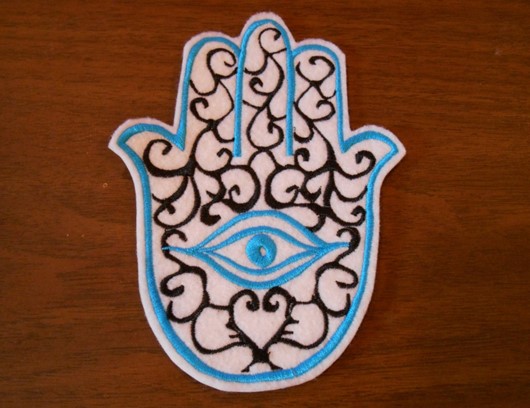
Image: Hamsa Hand
First of all, let us note that the Hamsa is known by many names. This is because it is an important symbol in almost every major religion. Here are some of its names.
- Hamsa: A transliteration of the Arabic “Jamsa” or “Khamsah” meaning five
- Hand of God: A general name
- Hand of Fatima: After Fatima, the daughter of the Islamic prophet
- Hand of Miriam: After Miriam, the sister of Aaron and Moses of Jewish faith
- Hand of Mother Mary: After Mary, the mother of Jesus in Christian beliefs
- Hamesh: Meaning 5 in Hebrew
- It’s also known by the variations Humes Hand, Khamesh and Khamsa.
Early origins
The Hamsa Hand stands as one of the most ancient symbols in recorded history, with origins tracing back several millennia. It is posited by scholars that this symbol predates all significant religions, many of which subsequently incorporated it to signify various elements of their faith. The Hamsa is believed to have its origins in Mesopotamia and Carthage, where it served as an amulet designed to ward off the evil eye, a notion prevalent across various cultures. Subsequently, it disseminated across various regions, achieving recognition on a global scale, although it initially garnered significant popularity in the Middle East and North Africa (Dani Rhys, 2023).
Table: Significance of the Hamsa Hand
| Hamsa Variation | Cultural Significance | Symbols | Usage |
| Fatima’s Hand | Islamic and Middle Eastern cultures | Eye symbol, five fingers | Jewelry, home decor, talisman |
| Hand of Miriam | Jewish culture | Star of David, menorah, Torah | Jewelry, wall hangings, amulets |
| Hand of Mary | Christian culture | Cross, Virgin Mary, Christian symbols | Religious spaces, jewelry, gifts |
Origins of the Hamsa Hand in Christianity
Biblical references
Jennifer Fitzgerald (2024) asserts that in examining the roots of the Hamsa Hand in Christianity, one must acknowledge the extensive scriptural connections that have influenced its importance. The Hamsa Hand, referred to as the Hand of Mary or Hand of Fatima, is thought to originate from the narrative of Mary, the mother of Jesus. Biblical stories indicate that the angel Gabriel visited Mary to announce the birth of Jesus. In numerous Christian traditions, the Hamsa Hand is regarded as a symbol of protection and heavenly favor, reflecting the safeguarding influence of the angel Gabriel in Mary’s life.
The biblical allusions to the Hamsa Hand encompass not only the narrative of Mary but also additional examples of supernatural safeguarding and direction (Fitzgerald, 2024). The Psalms have verses that describe God’s hand directing and guiding His people during challenging periods. The depiction of the hand as a symbol of strength and protection is well established in Christian symbolism, rendering the Hamsa Hand a potent emblem of trust and heavenly guidance.
Are there further occasions in which the Bible explicitly designates the Hand of God? Certainly. Nonetheless, those texts explicitly pertain to the spiritual essence of God’s presence in our life. Frequently, they depict God’s “hand of blessing” or “hand of punishment” contingent upon the situation (For example, refer to Deuteronomy 11:12). The references to God’s hand, His eyes, or the “strong arm of the Lord” are termed anthropomorphisms, a literary device that ascribes human traits to God. Nonetheless, these characteristics are not intended to be taken literally, as God, being a Spirit, does not possess a physical hand, mouth, or eyes (Sams, 2024).
Symbolism in Early Christianity
During the formative period of Christianity, the Hamsa Hand has profound significance as a symbol of faith and devotion. Early Christian cultures saw the hand as a potent talisman capable of repelling malevolence and bestowing blessings upon its bearers. The five fingers of the hand are frequently understood as symbolizing the five wounds of Christ, so associating the sign with the crucifixion and the ultimate sacrifice for humanity’s salvation.
The early Christian iconography of the Hamsa Hand also mirrors the prevailing cultural ideas of the day. During a period characterized by persecution and uncertainty, adherents sought emblems of protection and hope to fortify their faith. The Hamsa Hand, characterized by its elaborate design and profound spiritual significance, serves as a concrete reminder of divine presence and safeguarding among challenges.
“I believe we are currently in an era where an increasing number of individuals are experiencing isolation and loneliness,” asserts Glazer. The challenges of warfare, poverty, climate change, and several contemporary issues are intrinsically disruptive. A Hamsa serves as a reminder of God’s presence and the potential for good fortune to manifest in our lives. Maria Hayes, a spirituality specialist, asserts that the Hamsa can function as an amulet. It can protect you from injury, disease, or malevolent gaze.
In this setting, Mary’s hand serves as a potent symbol of God’s ability to manifest His purpose through the activities of ordinary individuals, endowing them with extraordinary skills and capacities. We might all benefit from a semblance of the Divine to surmount the problems in our lives, and the Hand of Mary serves as a reminder of this thought to Christians. This further underscore the universality of the human yearning for spiritual protection and solace.
Box: Interpretative Themes of the Hamsa Hand in Christianity
– Prosperity, wisdom, spirituality, peace, health, to bring blessings to the household, courage.
– Divine protection and blessings.
– The Hamsa hand only gives and asks for nothing in return.
– Popular symbol for warding off negativity today.
– Divine femineity, compassion and even fertility, justice, fairness and strength.
– Diversity, equity and inclusivity (DEI)
– Source of strength and hope in times of need.
-. Shield against negative energies.
– Brings about good fortune or good luck
– Christian iconography
Wrapping up
Overall, the Hamsa Hand is a widely used and respected emblem. The Hamsa symbol has many different meanings, but at its core, it represents protection against evil. Even today, many people keep the Hamsa Hand close as a symbol of protection and good fortune.
Finally, the Hamsa hand is a valuable and versatile emblem of protection in many cultures and religions. Its capacity to transcend boundaries demonstrates its power and universality.
As we continue to learn about and enjoy the rich history and significance of this ancient symbol, let us remember its essential message: that we can all find refuge, strength, and protection within its protective embrace. Indeed, in a world where differences frequently split, the Hamsa hand serves as a poignant reminder that disparate ideas can share common ground. May this revered icon inspire future generations with togetherness, understanding, and harmony.
References
- Dani Rhys (2023, November 8). Hamsa Hand: A Potent Symbol of Protection. Retrieved from https://symbolsage.com/hamsa-hand-meaning-and-symbolism/ (Accessed 25 October 2024).
- Fitzgerald, J. (April 8, 2024). Exploring the Christian Meaning of the Hamsa hand. Retrieved from https://vitalsparkhq.com/hamsa-hand-meaning-christianity/ (Accessed 26 October 2024).
- Nikita (2023, December 23). Cultural Symbols, Spirituality, Symbolism. Retrieved from https://symbolsandmeaningspedia.com/the-significance-of-the-hamsa-hand/ (Accessed 25 October 2024).
- Rivera, E.M. (2024). Hamsa hand: Spiritual Meaning. Spiritual Mojo. Retrieved from https://spiritualmojo.com/hamsa-hand-spiritual-meaning/ (Accessed 26 October 2024).
- Sams, Richard (2024). What Does the Hamsa Hand Signify in Christianity? Retrieved from https://digestfromexperts.com/3728/hamsa-hand-meaning-christianity/ (Accessed 25 October 2024).
 Dr. Remy Nyukorong